TL; DR
This document demonstrates how to modify the algorithm used for inference in our models. In general, the default algorithm (the NUTS from Stan) represents the gold standard, but it is slow. For initial screening (or even cross-validation), one can rely on the other algorithms showcased in this vignette. They tend to be faster, and produce reliable point estimates but have a weaker performance in quantifying the uncertainty around their estimates.
Setup
The setup and data-processing for this vignette is the same as in the “Advanced features” vignette. For further details, see vignette("advanced-features", "drmr"). Unlike the examples in that vignette, we will not split the data into train and test, but rather just look at parameters’ estimates obtained through different algorithms.
Linking to GEOS 3.12.1, GDAL 3.8.4, PROJ 9.4.0; sf_use_s2() is TRUE
This is bayesplot version 1.16.0
- Online documentation and vignettes at mc-stan.org/bayesplot
- bayesplot theme set to bayesplot::theme_default()
* Does _not_ affect other ggplot2 plots
* See ?bayesplot_theme_set for details on theme setting
Attaching package: 'dplyr'
The following object is masked from 'package:drmr':

    between
The following objects are masked from 'package:stats':

    filter, lag
The following objects are masked from 'package:base':

    intersect, setdiff, setequal, union
## loads the data
data(sum_fl)

## computing density
sum_fl <- sum_fl |>
  mutate(dens = 100 * y / area_km2,
         .before = y)

avgs <- c("stemp" = mean(sum_fl$stemp),
          "btemp" = mean(sum_fl$btemp),
          "depth" = mean(sum_fl$depth),
          "n_hauls" = mean(sum_fl$n_hauls),
          "lat" = mean(sum_fl$lat),
          "lon" = mean(sum_fl$lon))

min_year <- sum_fl$year |>
  min()

## centering covariates
sum_fl <- sum_fl |>
  mutate(c_stemp = stemp - avgs["stemp"],
         c_btemp = btemp - avgs["btemp"],
         c_hauls = n_hauls - avgs["n_hauls"],
         c_lat   = lat - avgs["lat"],
         c_lon   = lon - avgs["lon"],
         time  = year - min_year)

## mortality rates
fmat <-
  system.file("fmat.rds", package = "drmr") |>
  readRDS()

shp_sum_fl <- system.file("maps/sum_fl.shp", package = "drmr") |>
  st_read()
Reading layer `sum_fl' from data source
  `/home/runner/work/_temp/Library/drmr/maps/sum_fl.shp' using driver `ESRI Shapefile'
Simple feature collection with 10 features and 3 fields
Geometry type: MULTIPOLYGON
Dimension:     XY
Bounding box:  xmin: -75.77033 ymin: 35.18407 xmax: -65.67583 ymax: 44.4013
Geodetic CRS:  WGS 84
For an extensive list of the variables present in this dataset run: ?sum_fl.
Fitting a model using different algorithms
We will start with the default algorithm (NUTS). By default, it runs 4 chains sequentially, with a warmup period od 1000 samples and, subsequently, 1000 samples per chain. Here, we are running two chains in parallel, with a warmup of 500 and drawing 500 samples.
nuts_args <- list(parallel_chains = 2,
                  chains = 2,
                  iter_sampling = 500,
                  iter_warmup = 500,
                  show_messages = FALSE,
                  show_exceptions = FALSE)

drm_nuts <-
  fit_drm(.data = sum_fl,
          y_col = "dens", ## response variable: density
          time_col = "year", ## vector of time points
          site_col = "patch",
          family = "gamma",
          seed = 2026,
          formula_zero = ~ 1 + c_hauls,
          formula_rec = ~ 1 + c_stemp + I(c_stemp * c_stemp),
          formula_surv = ~ 1,
          f_mort = fmat[, -1],
          n_ages = NROW(fmat),
          adj_mat = adj_mat, ## A matrix for movement routine
          ages_movement = c(0, 0,
                            rep(1, 12),
                            0, 0), ## ages allowed to move
          .toggles = list(ar_re = "rec",
                          movement = 1,
                          est_surv = 1,
                          est_init = 0,
                          minit = 1),
          algo_args = nuts_args)
Warning: 2 of 1000 (0.0%) transitions ended with a divergence.
See https://mc-stan.org/misc/warnings for details.
Next, we obtain samples from the variational posterior using Stan’s Automatic Differentiation Variational Inference (ADVI) algorithm (for for details see this link).
## in our tests, this algorithm has been the least stable so far.

advi_args <- list(show_messages = FALSE,
                  show_exceptions = FALSE,
                  iter = 10^5, ## maximum number of iterations (optimization)
                  draws = 4000) ## number of samples from the posterior

drm_advi <-
  update(drm_nuts,
         algo_args = advi_args,
         algorithm = "vb") ## vb stands for variational Bayes
Another algorithm option is the Pathfinder. Pathfinder also relies on variational inference. It is usually better than ADVI, especially when the posteriors (in the unconstrained space) are not unimodal and bell-shaped. We will demonstrate how the inference algorithm can be updated using the update method:
path_args <- list(show_messages = FALSE,
                  show_exceptions = FALSE,
                  max_lbfgs_iters = 10^4)

drm_path <-
  update(drm_nuts,
         algo_args = path_args,
         algorithm = "pathfinder")
It is also possible to obtain samples from a Laplace approximation of the posterior as follows:
lapl_args <- list(show_messages = FALSE,
                  show_exceptions = FALSE)

drm_lapl <-
  update(drm_nuts,
         algo_args = lapl_args,
         algorithm = "laplace")
Rejecting initial value:
  Log probability evaluates to log(0), i.e. negative infinity.
  Stan can't start sampling from this initial value.
Rejecting initial value:
  Log probability evaluates to log(0), i.e. negative infinity.
  Stan can't start sampling from this initial value.
Rejecting initial value:
  Log probability evaluates to log(0), i.e. negative infinity.
  Stan can't start sampling from this initial value.
Initial log joint probability = -57554.4
    Iter      log prob        ||dx||      ||grad||       alpha      alpha0  # evals  Notes
Exception: Exception: gamma_lpdf: Inverse scale parameter[1] is inf, but must be positive finite! (in '/tmp/RtmpOmMiLa/pkg-lib1a4170683f5f/drmr/bin/stan/utils/lpdfs.stanfunctions', line 97, column 4, included from
'/tmp/RtmptcMIhf/model-274c2a88beed.stan', line 2, column 0) (in '/tmp/RtmptcMIhf/model-274c2a88beed.stan', line 363, column 2 to line 366, column 67)
Exception: Exception: gamma_lpdf: Inverse scale parameter[1] is inf, but must be positive finite! (in '/tmp/RtmpOmMiLa/pkg-lib1a4170683f5f/drmr/bin/stan/utils/lpdfs.stanfunctions', line 97, column 4, included from
'/tmp/RtmptcMIhf/model-274c2a88beed.stan', line 2, column 0) (in '/tmp/RtmptcMIhf/model-274c2a88beed.stan', line 363, column 2 to line 366, column 67)
Error evaluating model log probability: Non-finite gradient.
Error evaluating model log probability: Non-finite gradient.
Error evaluating model log probability: Non-finite gradient.
      99       46.6639     0.0479171       43.2853           1           1      130
    Iter      log prob        ||dx||      ||grad||       alpha      alpha0  # evals  Notes
     199       61.6008     0.0301142       7.29015           1           1      255
    Iter      log prob        ||dx||      ||grad||       alpha      alpha0  # evals  Notes
     299        63.065     0.0212004       14.0507           1           1      376
    Iter      log prob        ||dx||      ||grad||       alpha      alpha0  # evals  Notes
     399       64.2728      0.022789       18.6164           1           1      504
    Iter      log prob        ||dx||      ||grad||       alpha      alpha0  # evals  Notes
     499       64.4237    0.00170634       3.21613           1           1      623
    Iter      log prob        ||dx||      ||grad||       alpha      alpha0  # evals  Notes
     599       64.4604     0.0135798        2.8787      0.3004           1      743
    Iter      log prob        ||dx||      ||grad||       alpha      alpha0  # evals  Notes
     699       64.4731    7.2782e-05       1.23404        0.24        0.24      867
    Iter      log prob        ||dx||      ||grad||       alpha      alpha0  # evals  Notes
     799       64.4764   0.000123441      0.187555           1           1      988
    Iter      log prob        ||dx||      ||grad||       alpha      alpha0  # evals  Notes
     899       64.4771   3.91112e-05      0.118811           1           1     1103
    Iter      log prob        ||dx||      ||grad||       alpha      alpha0  # evals  Notes
     912       64.4771   2.00926e-05      0.040848           1           1     1119
Optimization terminated normally:
  Convergence detected: relative gradient magnitude is below tolerance
Finished in  0.9 seconds.
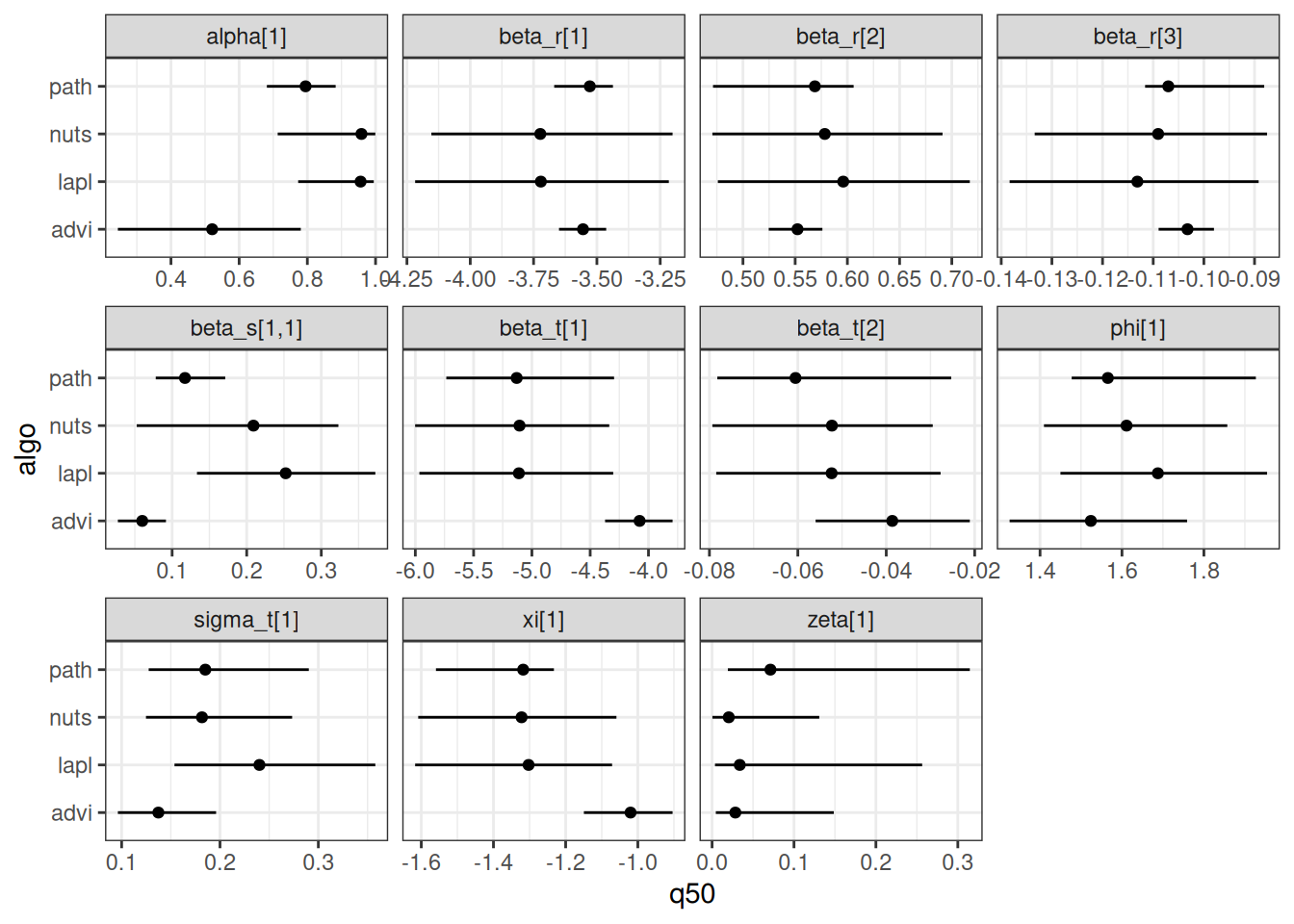
The code below computes the parameter estimates for each of the methods, and then makes a graph to compare them.
bind_rows(
    mutate(summary(drm_nuts)$estimates, algo = "nuts"),
    ## mutate(summary(drm_advi)$estimates, algo = "advi"),
    mutate(summary(drm_path)$estimates, algo = "path"),
    mutate(summary(drm_lapl)$estimates, algo = "lapl")
) |>
  ggplot(data = _,
         aes(x = q50,
             y = algo)) +
  geom_linerange(aes(xmin = q5, xmax = q95)) +
  geom_point() +
  facet_wrap(~ variable, scales = "free_x") +
  theme_bw()
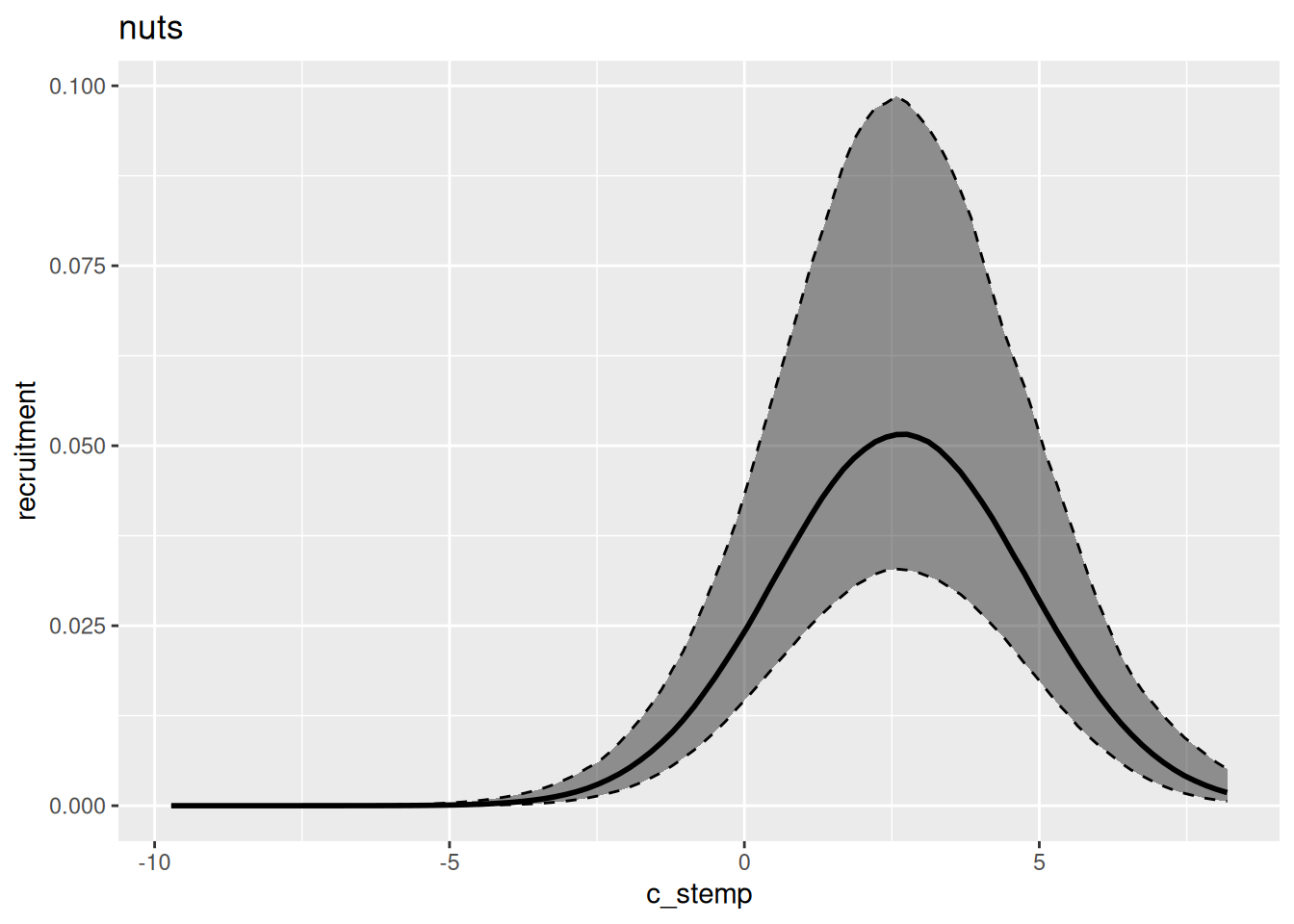
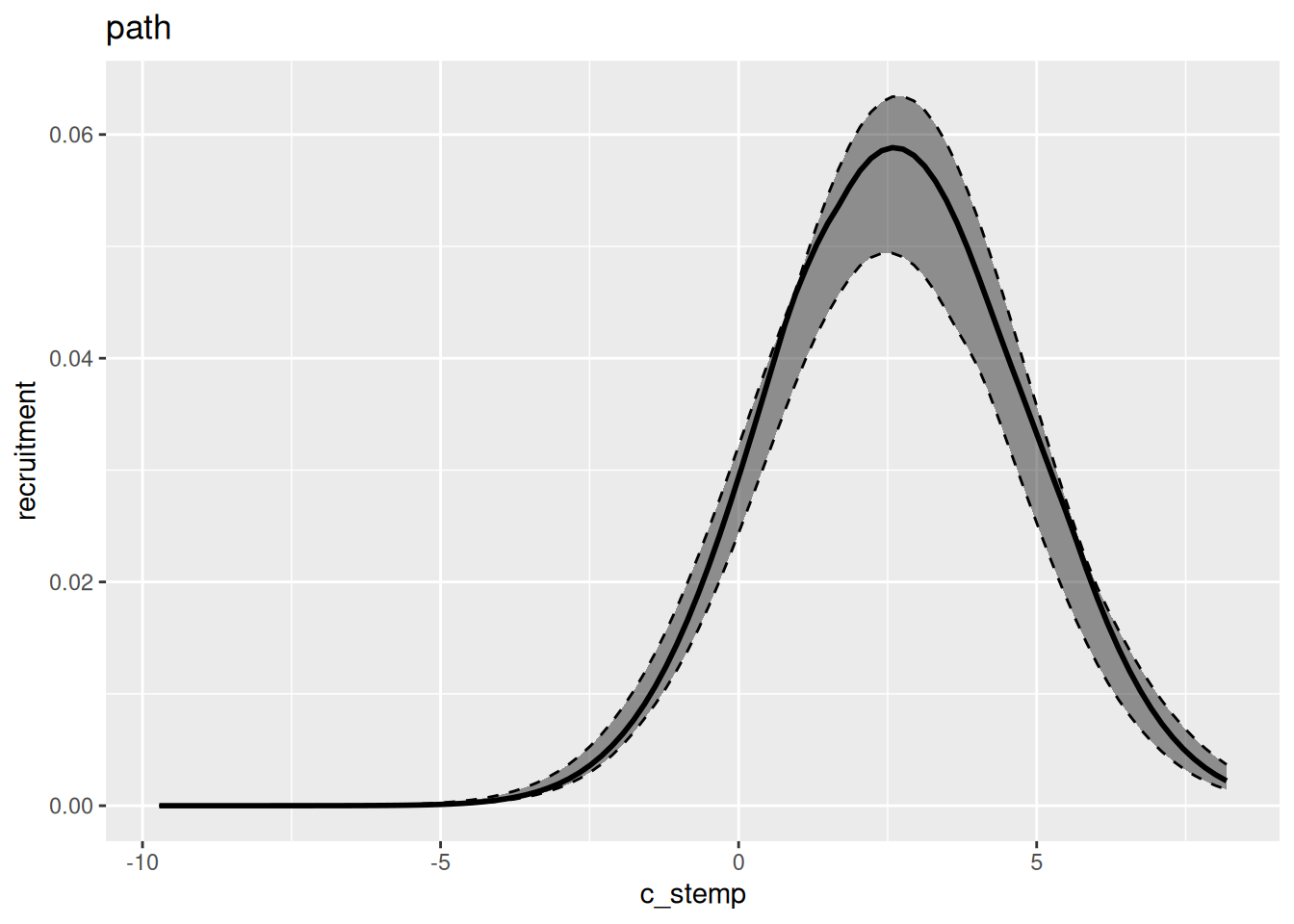
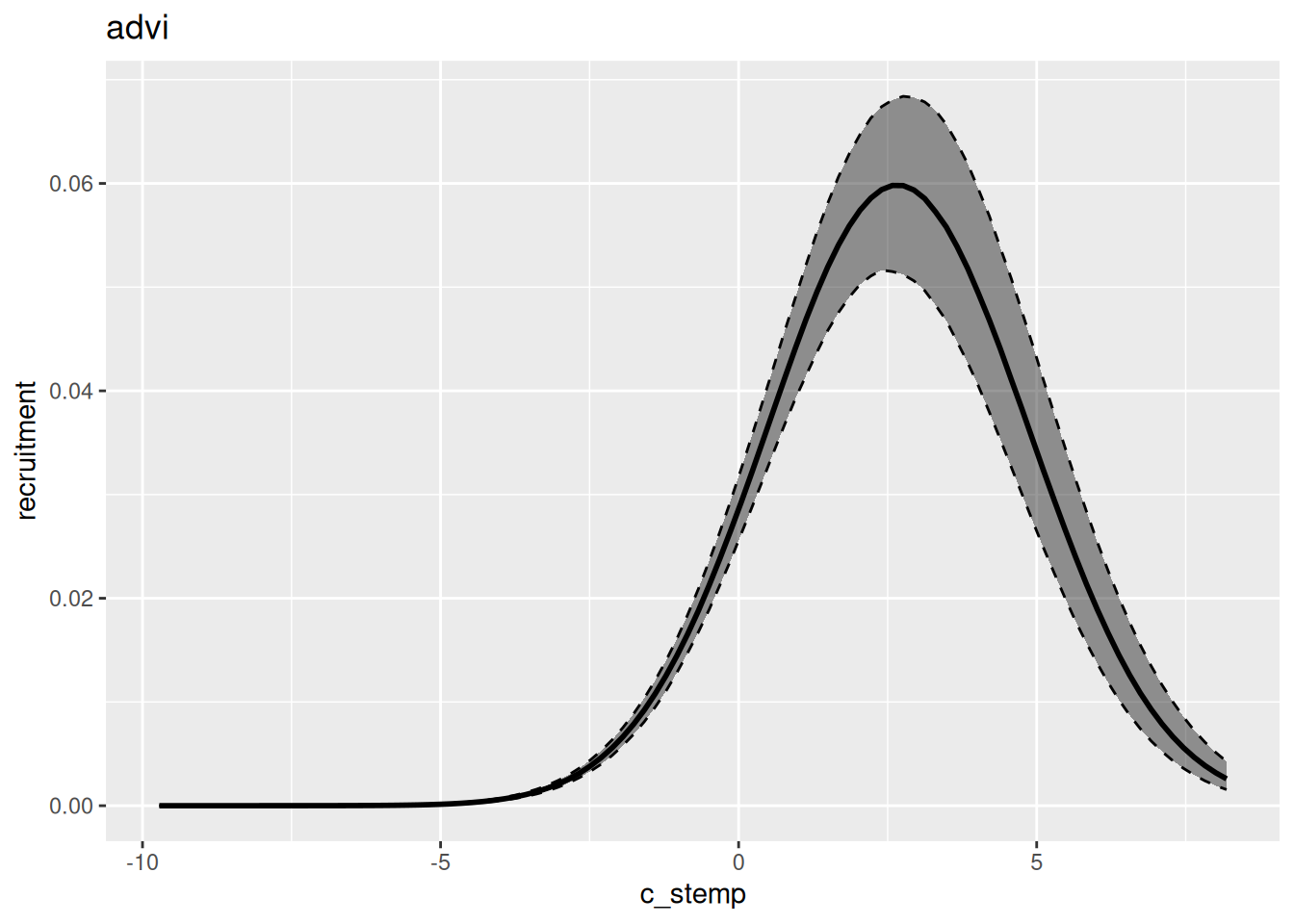
In general, variational inference methods are known for underestimating the uncertainty around the parameter estimates. We can also look at the estimated relationship between environment and recruitment for each of those methods:
effects_drm(drm_nuts, "rec", "c_stemp") |>
  plot() +
  labs(title = "nuts")
effects_drm(drm_path, "rec", "c_stemp") |>
  plot() +
  labs(title = "path")
## effects_drm(drm_advi, "rec", "c_stemp") |>
##   plot() +
##   labs(title = "advi")

effects_drm(drm_lapl, "rec", "c_stemp") |>
  plot() +
  labs(title = "lapl")